
Medium
The $x-t$ graph of a particle moving along a straight line is shown in the figure. The $v-t$ graph of the particle is correctly shown by:
- A
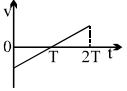
- B
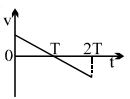
- C
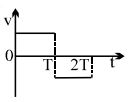
- D
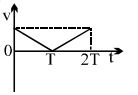
Explore More
Similar Questions
Two small blocks slide without losing contact with the surface along two frictionless tracks $1$ and $2$,starting at the same time with the same initial speed $v$. Track $1$ is perfectly horizontal,while track $2$ has a dip in the middle,as shown in the figure. Which block reaches the finish line first? [Hint: Use velocity-time graph to solve]
MediumKVPY 2009
View SolutionAn object at rest at the origin begins to move in the $+x$-direction with a uniform acceleration of $1 \, m/s^2$ for $4 \, s$ and then it continues moving with a uniform velocity of $4 \, m/s$ in the same direction. The $x-t$ graph for the object's motion will be:
$A$ bullet is shot vertically downwards with an initial velocity of $100\,m/s$ from a certain height. Within $10\,s$,the bullet reaches the ground and instantaneously comes to rest due to a perfectly inelastic collision. The velocity-time curve for the total time $t = 20\,s$ will be: (Take $g = 10\,m/s^2$)
DifficultJEE MAIN 2022
View SolutionThe displacement-time graph of a moving particle is shown below. The instantaneous velocity of the particle is negative at the point:
Is the statement 'The slope of a position-time graph can be negative' true or false?
Easy
View SolutionVedclass Products
For Students
Vedclass Test Series
Mock tests in real JEE/NEET style with performance analysis. 5-day free trial.
Start Free TrialFor Teachers
Exam Paper Generator
Generate Set A/B/C/D exam papers from 7.5L+ questions in 2 minutes. 3 chapters free.
Try FreeFor Institutes
Online Exam Module
Live online exams with unlimited students, 360° analytics & white-label branding.
See Demo